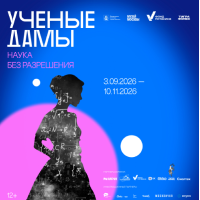
On September 2, the Museum of Moscow hosted the opening of Women of Science. Science Without Permission, an exhibition timed to coincide with the premiere of the documentary animated series of the same name. This large-scale multimedia, multiplatform project was created with the support of the Vladimir Potanin Foundation in partnership with Tigra Films. It is dedicated to women who, over the past century and a half, pursued science despite technological limitations and gender barriers. At the heart of the project is the joy of discovery as the driving force behind scientific inquiry.
.jpg)
The project is built around eight scientific disciplines: physics, mathematics, chemistry, geology, microbiology, cognitive science, climatology, and astronomy. While the series focuses on the biographies of its historical protagonists, the exhibition brings the research process itself to the forefront, tracing the path toward discovery — a path that is never linear.
Each exhibition hall brings together three dimensions. The historical dimension presents timelines of the lives and work of scientists of the past: Alexandra Glagoleva-Arkadieva, Sofia Kovalevskaya, Olga Ladyzhenskaya, Yulia Lermontova, Natalia Kind, Zinaida Yermolyeva, Nadezhda Ladygina-Kohts, Evgenia Rubinstein, and Nina Subbotina. The associative dimension features science-art objects, while the contemporary dimension introduces dialogues with scientists working today — winners of the Foundation's fellowship and grant competitions.
.jpg)
The project speaks two languages — those of science and art. Scientific ideas are explored through human stories, science-art works, and interactive exhibits, including objects designed to be experienced through touch.
.jpg)
Tigra Films producers Anna Kolchina and Anastasia Koretskaya highlighted the unique nature of an idea that "grew into an entire ecosystem, where the series and the exhibition complement one another without ever repeating each other."
We were fortunate that the Foundation and our team shared the same vision for the project. Above all, we want young people — high school and university students — to take a closer look at the natural sciences and say: 'Look how exciting science can be! It doesn't have to be boring. It can be fascinating, and it really matters,' Anna added.
.jpg)
Natalia Katonova, Academic Secretary of the Museum of Moscow, emphasized the special role museums play in this process:
Everything a museum does can, first and foremost, be described as popularizing scientific knowledge. For our museum, whose entire work is grounded in research, this synergy with today's project is especially important. Together, we want to convey to our visitors the value of knowledge and its extraordinary power to inspire.
The curatorial selection of science-art works by contemporary artists was curated by the Art & Science Center at ITMO University. Its curator, Olga Vad, emphasized the value of interdisciplinary exchange and scientific understanding within an art project:
What we have created is a hybrid exhibition. Usually, you go to a museum to see art, or to learn about the history of science, or to explore something related to technology. Very rarely do all these narrative strands come together. Here, you can discover the stories of women who advanced science before the Revolution and during the Soviet period, and then trace the development of their research into the present day. It turns out that what great women scientists accomplished many decades ago has left traces and consequences not only in specific inventions, but also in subtle artistic forms. It is very important to us that art & science adds a powerful emotional dimension to the exhibition.
.jpg)
Narrative curator Dmitry Likin also spoke about the project's emotional dimension:
This is a story about the depths, the context, and the circumstances from which something extraordinary can emerge — that powerful inner spring that each of our protagonists set in motion, turning it into a full scientific life: not always a career, perhaps, but always a life filled with remarkable discoveries.
Scientific curator Nikita Lavrenov described the "joy of discovery" as the defining idea of the project — not only for the exhibition's historical protagonists, women who came from very different backgrounds and circumstances, but also for scientists working today, himself included:
I also turned to my own experience. Why do I do science in an underground laboratory in the first place? I think what unites all of us is the joy of discovery. It is the feeling every scientist knows — the feeling that drove our protagonists to overcome obstacles and accomplish so much against the odds. Through their stories, we want visitors to understand that joy of discovery intellectually, to feel it through art, and to experience it for themselves through the interactive exhibits.
For chief curator Nina Gomiashvili, the project also became a personal experience. She thanked the team and noted how her colleagues' scientific approach helped "bring huge clouds of fantasies about science down to earth and allowed us to look both back and ahead at what these great women have done for all of us."
.jpg)
Oksana Oracheva, General Director of the Vladimir Potanin Foundation, devoted her remarks to the power and significance of women's contribution to science:
It is extremely important to support breakthrough ideas in science and education. I deliberately bring the two together: science is impossible without education. You first have to learn what is already known before you can create something new. The world's oldest educational institution was founded in the ninth century in Fez, Morocco, when Fatima al-Fihri established Al-Qarawiyyin, which remains in operation today — more than 1,200 years later. Fatima used her inheritance to establish this center of learning — the word 'university' did not yet exist at the time. To me, this shows how important it is to know our history and to see the people who are prepared to overcome enormous challenges in order to create something new — something that can endure for centuries.
For more than 25 years, the Vladimir Potanin Foundation has supported education in Russia, helping students and university faculty develop, create, become innovators and professors. Of course, it is important to us that their work is visible beyond laboratories and universities. Science and education are not easy subjects to communicate. This is why the multi-format, hybrid nature of the Women of Science project is particularly valuable to us. It demonstrates that complex ideas can be explained in accessible language — and, in doing so, can inspire a new generation of students and educators to pursue ideas that are exciting, new, and bold.
.jpg)
Women of Science brings together 34 winners of the Foundation's Fellowship Program competitions from across Russia. Five of them — Venera Ishmukhametova, Natalia Guseva, Alexandra Ivanova, Konstantin Tereshchenko, and Pavel Gavryushkin — appear in the series. Another 29 contributed to the exhibition as experts. They represent Saratov, Novosibirsk, Kazan, Irkutsk, Yakutsk, Tomsk, St. Petersburg, Tyumen, Nizhny Novgorod, Yaroslavl, Samara, Stavropol, Chelyabinsk, and Moscow.
The series is available to watch on the Okko streaming service and on the Odnoklassniki social network.
The exhibition at the Museum of Moscow will remain open through November 10.
Together, let us imagine that science begins not with formulas, but with a question anyone can ask: "What if?"
See you at the museum!
 Logo
Logo